Hint 1
Borrowing and lending can get quite complicated. To make things easier, you should think of each transaction only in terms of one person lending money to another. Doing this means you need to find five transactions.
You already know two...
Each of these five people has borrowed money from one of the others, and each has lent money to one of the others. You know that none of them has lent money to more than one person, and none of them has borrowed money from someone that they have lent money to. You also know these facts:
1. B borrowed money from A. 2. E did not lend money to A. 3. C lent money to D.
Who did A borrow money from? Circle your answer.

Borrowing and lending can get quite complicated. To make things easier, you should think of each transaction only in terms of one person lending money to another. Doing this means you need to find five transactions.
You already know two...
You know who A and C lent money to, but not who B, D and E did.
However, since B borrowed money from A, and D borrowed money from C, you know that B, D and E must have lent money to one of A, C and E.
From Hint 2, you know that E lent money to either A, C or E. Of course, you can't lend money to yourself, so that leaves A or C, and you can eliminate A based on the information in the puzzle. So E lent money to C.
That leaves two more transactions to find...
1 / 2
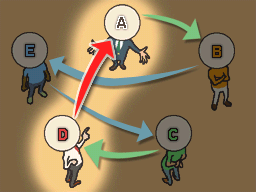
That's right! A borrowed money from D.
If you trace the flow of money according to the stated conditions, the answer becomes obvious.
Hints you open and puzzles you mark solved are kept in this browser.