Hint 1
It might be easiest to divide the liquid into five doses by looking at the bottle from the bottom. If each square portion is one dose, then on the first day you would drink one square, and on the next day, you'd need to drink one more.
Dr. Schrader needs to drink 1/5 of this bottle of medicine per day over a period of five days. Unfortunately, the bottle isn't marked, so there's no way of telling the dosage from it.
Now it's time to take the second dose. The medicine in the bottle has been reduced as shown in the diagram. Where should he stop drinking today? Draw a line on the bottle to mark the stopping point.
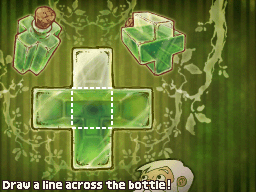
It might be easiest to divide the liquid into five doses by looking at the bottle from the bottom. If each square portion is one dose, then on the first day you would drink one square, and on the next day, you'd need to drink one more.
No matter how you tilt the bottle, there's no good way to get an even "square's worth" of medicine. So, how could you get that amount by dividing things up another way? For example, you could try putting two squares side by side, making a rectangle, and then drawing a line down the middle from corner to corner. The resulting triangle would equal the amount in one of the original squares.
Try finding the potential rectangles talked about in Hint Two. You can create two horizontal rectangles using the center square and the square to its left or right.
You've got to draw a line through one of the two rectangles talked about in Hint Three. Try to figure out which direction to draw the line in.
That's right!
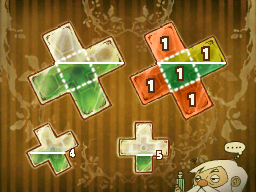
You can turn the bottle left or right and it will still work. Looking at the diagram, you can see that a diagonal line like the one shown divides the long rectangle into two. Since the rectangle makes up 2/5 of the medicine, halving it creates just the right amount!
Hints you open and puzzles you mark solved are kept in this browser.