Hint 1
At first glance, the five patterns don't seem to have any relation to each other whatsoever. Try to ignore the fact that they are made of L-shaped pieces, and consider each pattern as a whole.
A schoolteacher called a bright pupil up to the front of the class and asked him this:
"Do you see these five patterns? Each one is made using two paper L shapes. None are rotations or mirrored versions of any other, yet they all have something in common. Using these two L shapes, can you make another pattern that shares the common feature of the other five?"
Move and rotate the pieces to form a sixth pattern that shares the common feature.
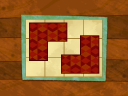
At first glance, the five patterns don't seem to have any relation to each other whatsoever. Try to ignore the fact that they are made of L-shaped pieces, and consider each pattern as a whole.
Each pattern looks very flat, but like origami, they should be properly expressed on a three-dimensional plane.
What would you get if you put the two L shapes together and folded along each square segment?
Each of these patterns is a net that can be used to make a six-sided cube.
Excluding mirrored or rotated patterns, there are only six possible ways to form a cube using the two L shapes. You've already seen five, so this last one is up to you.
Here's your final hint:
Arrange the L shapes to make a staircase pattern that has two squares of paper in each row. How does that look?
Excellent!
They're all fine examples of an unfolded cube! That's why this pattern would work even if it was mirrored.
Hints you open and puzzles you mark solved are kept in this browser.