Hint 1
If you try to consider the entire cube at once, you'll just end up in a muddle.
Try taking it one row at a time, starting from the view that shows the fewest gems for that particular row.
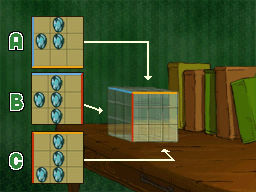
Twenty-seven glass boxes have been stacked together to form a cube.
Some of the glass boxes have a gemstone inside. Image A shows a view of the cube from above, B shows a view from the side, and C shows a view from the front.
How many of the boxes contain gems?
If you try to consider the entire cube at once, you'll just end up in a muddle.
Try taking it one row at a time, starting from the view that shows the fewest gems for that particular row.
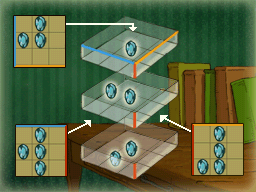
Views B and C look at the cube from the side. When working out how many gems there are in the topmost row, you only need to consider the top rows of these views. Try comparing them with view A. In views B and C, there is one gem in the central column of each. These views can't contradict one another, so there can only be one gem, right in the center of the row. This corresponds with the central gem in view A.
For the second row from the top, you only need to consider the middle row of views B and C.
From view B you can see two gems, while for view C you can see one. For these views to agree, there can only be two gems. This doesn't contradict view A, either.
When working out how many gems are in the bottommost row, look at the bottom rows of views B and C.
In view C, two gems can be seen, but in view B, only one can. The only way views A, B, and C can agree is if there are two gems in this row.
How many are there in total?
05
Correct!
Only five of the boxes contain gemstones. Less than it might seem at first, eh?
Hints you open and puzzles you mark solved are kept in this browser.