Hint 1
A quick calculation will tell you that if the rabbit jumps forwards 70 cm and then jumps 30 cm backwards in the direction of its tail, it will cover 40 cm of ground every two jumps. Isn't there a way of making slightly faster progress?
An uncommonly clever rabbit has imposed some rather strange rules upon its movement. It can jump 70 cm forwards, but after every jump forwards, it must jump 30 cm in the direction of its tail.
If this rabbit needed to travel 10 m in a straight line, what is the lowest number of jumps in which it could cover the distance?
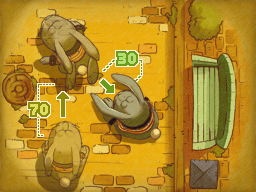
A quick calculation will tell you that if the rabbit jumps forwards 70 cm and then jumps 30 cm backwards in the direction of its tail, it will cover 40 cm of ground every two jumps. Isn't there a way of making slightly faster progress?
By performing a certain action after jumping 70 cm forwards, the rabbit can allow itself to jump even further towards its goal.
Think of a way to avoid wasting the 30 cm jump in the direction of its tail.
The key to this puzzle is rotation.
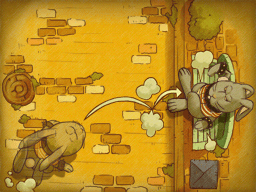
By turning on the spot, the rabbit is able to jump even further towards its goal.
After the first jump, the rabbit turns around 180 degrees and performs its second jump. When it lands, it turns around again and starts its next jump. Repeating this pattern is the most efficient way of moving towards its goal, even if it does make the poor rabbit dizzy...
20
That's right!
The answer is 20 jumps. After every 70 cm jump forwards, the rabbit turns around 180 degrees and jumps a further 30 cm in the direction of its tail, thereby covering 1 m in two jumps.
Hints you open and puzzles you mark solved are kept in this browser.