Hint 1
It's easy to divide the medicine into five doses when looking at the bottle from the bottom. If each square contains one dose, then on the first day you would drink one square, and on the second day you'd drink one more.
Dr Schrader needs to drink one fifth of this bottle of medicine per day over a period of five days. Unfortunately, the dosages aren't marked on the bottle.
Dr Schrader has taken the first dose, and the amount of medicine in the bottle has been reduced to the level shown in the diagram. It's now time for the second dose.
To where should he drink today? Draw a line on the bottle to mark the point at which he should stop drinking.
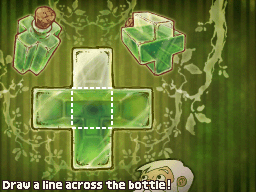
It's easy to divide the medicine into five doses when looking at the bottle from the bottom. If each square contains one dose, then on the first day you would drink one square, and on the second day you'd drink one more.
No matter how you tilt the bottle, there's no way of getting the medicine to lie evenly within the outlines of the squares. You must therefore find the required dosage by dividing the squares another way. For example, you could try combining two adjacent squares that make a rectangle, then drawing a diagonal line through the middle. The resulting triangle would contain the same amount of medicine as one of the squares.
Try finding the kind of rectangles talked about in Hint 2. You can create two horizontal rectangles using the centre square and the square to its left or right.
You've got to draw a line through one of the two rectangles talked about in Hint 3.
Think about the angle of this line.
That's right!
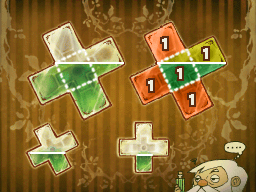
You can rotate the bottle left or right and get the same result. Just make sure the medicine reaches the line you drew.
Looking at the diagram, you can see that a diagonal line like the one shown divides the rectangle into two. Since the rectangle makes up two fifths of the medicine, halving it gives you just the right amount!
Hints you open and puzzles you mark solved are kept in this browser.