Hint 1
The first thing to notice is the number of tooth marks. There are six, three on each side. That must mean the fish that made this bite mark has three pairs of teeth.
This fossil was found on a riverbed. Close examination revealed tooth marks, suggesting that it was formed when some kind of ancient fish bit into something tasty.
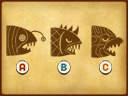
Can you tell which one of the fish pictured in the book made these tooth marks?
The first thing to notice is the number of tooth marks. There are six, three on each side. That must mean the fish that made this bite mark has three pairs of teeth.
Compare the three fish. Each of them has three pairs of teeth on either the upper jaw or the lower jaw.
C has rounded teeth, but that doesn't necessarily mean it couldn't make this bite mark.
Is there anything else about the fish that sets them apart? Maybe the position of the teeth?
Have another look at the fossil. If the fish had this object in its mouth and bit into it, wouldn't it have made more tooth marks towards the edge?
Unless it had teeth arranged so that there wouldn't be tooth marks on the edge of the fossil...
If the fish had a mouth full of teeth, there wouldn't be such a gap between the tooth marks and the edge of the object after it was bitten.
This fish must not have had any back teeth.
A
Correct!
The answer is A.
The shape of the teeth is irrelevant. Looking at the bite mark as a whole, you can see that only three pairs of front teeth made an impression, so only a fish without any back teeth could have made these marks.
Hints you open and puzzles you mark solved are kept in this browser.