Hint 1
First, consider the number of petals on a single flower in each bouquet. It all starts there.
A young man tells his local florist about three games he intends to play by picking petals off flowers one at a time.
He'll start with "she loves me, she loves me not" and move on to "happy, unhappy, so-so". With the final flower he'll choose whether to buy his sweetheart "a bouquet, a cake, a ring or a book".
The florist picks out the bouquet that he thinks will give the best answer on the last petal of each flower. Which bunch does the young man walk away with?
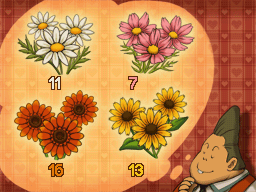
First, consider the number of petals on a single flower in each bouquet. It all starts there.
The man intends to play three different fortune-telling games with the flowers he buys.
Which outcome is best in each game? Keep in mind that the man probably has a preferred outcome for the first two, but he does not actually know which gift would be best for his sweetheart.
It's important to remember that the florist is the one picking out the bouquet for this man to play the fortune-telling games with. Think about it from the florist's point of view.
The best outcomes are "she loves me", "happy" and "bouquet".
To get "she loves me", you would need a flower with any of these numbers of petals: 1, 3, 5, 7, etc. To get "happy", you need a flower with any of these numbers of petals: 1, 4, 7, 10, etc.
What about "bouquet"? You need to find one common number that achieves the desired outcome in all three games.
Correct!
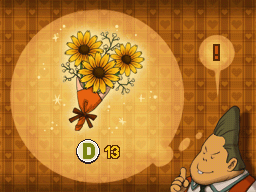
The young man took away the flowers with 13 petals each. The results of his games were "she loves me", "happy" and "bouquet".
It seems reasonable that a florist would want the man to buy another bouquet, right?
Hints you open and puzzles you mark solved are kept in this browser.