Hint 1
This type of spiderweb consists of radial support threads and sticky spiral threads that catch prey.
Normally, the spider would only travel along the non-sticky radials, but this spider is particularly unusual!
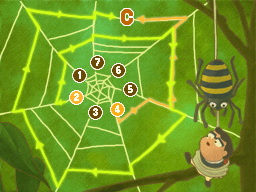
A spider made a particularly intricate web.
When its prey gets stuck at A, the spider starts from thread 2 or 5 to get it. To get to prey at B, the spider uses thread 1 or 2.
The spider uses a simple rule, so which two threads could the spider start from to get to C?

This type of spiderweb consists of radial support threads and sticky spiral threads that catch prey.
Normally, the spider would only travel along the non-sticky radials, but this spider is particularly unusual!
Find the path the spider takes to A when starting at thread 2 or 5. Maybe you will stumble on the rules the spider uses if you try different routes.
This spider always heads away from the centre of its web, but when it meets a junction, it turns. The spider will never ignore a junction on its way to its prey.
Try thinking about the prey instead of a starting thread. The spider can get to C from either the left or right depending on which thread it starts from. So, try tracing both routes backwards to the start.
Preycisely!
From wherever the spider starts, it always travels outwards and turns whenever it meets another connecting thread.
Oh, goody! It's lunch time!
Hints you open and puzzles you mark solved are kept in this browser.