Hint 1
Since the puzzle tells you that no one got on the train during the journey, it's safe to say that the number of passengers on the train never increased.
A number of people are on a train. At the first station the train pulls into, 1/6 of the people on board get off. At the next station, 1/5 of the remaining passengers get off. This pattern continues so that at the next station 1/4 get off, then 1/3 and then 1/2. Then, at the final station, all remaining passengers get off the train.
Assuming no one got on the train during the journey, what is the lowest number of people who could have been on the train when it set out?
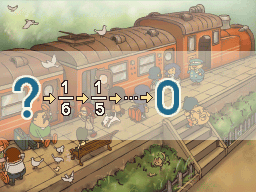
Since the puzzle tells you that no one got on the train during the journey, it's safe to say that the number of passengers on the train never increased.
Since 1/6 of the passengers get off at the first station, you know the number must be divisible by six. Start by choosing a number that's divisible by six and see what happens.
The principle by which this puzzle is solved should soon become evident.
Imagine that 30 passengers are on the train when it departs. At the first station, the train loses 1/6 of its passengers, meaning five people get off. At the next station, 1/5 of the remaining 25, or five people, get off. At the next station, 1/4 of the remaining 20, which is to say five more people, get off.
Do you notice a pattern here?
6
Good work!
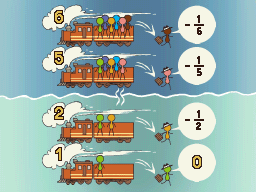
If you assume the train started out with six passengers, then only one person would have to get off at each station.
This puzzle can be really tough if you don't remember to reduce the number of people remaining on the train at each station along the way.
Hints you open and puzzles you mark solved are kept in this browser.