Hint 1
There are 51 numbers you can choose from, but since you're trying to get the largest total possible, you might want to try the bigger numbers first.
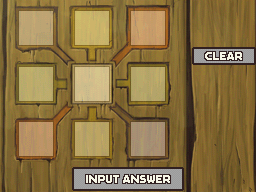
Nine squares are carved into a piece of wood.
Arrange nine unique numbers between one and 51 so that any three numbers have the same sum when added vertically, horizontally, or diagonally.
While several combinations are possible, your task is to find the number that occupies the center square when you arrange the numbers to yield the highest possible total.
There are 51 numbers you can choose from, but since you're trying to get the largest total possible, you might want to try the bigger numbers first.
As stated in Hint One, you should place large numbers in your square.
Use the numbers 43 through 51 when formulating your answer.
It might not seem obvious at first, but the center number is used in every single tabulation. Since you're trying to get the largest sums possible, doesn't it make sense to put the largest number right in the middle?
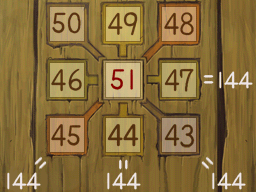
51
Great job!
To get the largest total possible from any three vertical, horizontal, or diagonal numbers, you should place the largest number available in the middle square.
Once you've decided on that as your middle number, all you need to do is test whether you can complete the square.
The full solution should look something like the diagram above.
Hints you open and puzzles you mark solved are kept in this browser.